Monday, April 13, 2015

PEV WEEKEND

Obviously not at the NCPEV street booth, the totally solar electric MOG was in her Wilmington, NC slip.

ELECTRIC AZALEA

No, it is not a new rock group but the folks from Advanced Energy, NCPEV definitely rocked the Wilmington Azalea Festival in the middle of Front and Chestnut Streets. From Raleigh, NC came the team that showed where the future for personal Plug-in Electric Vehicles (PEV) is headed and just how all of the folks in NC are going to get there.

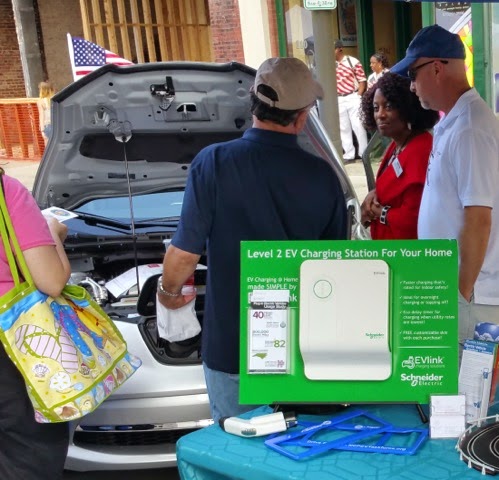
On display were child and adult oriented displays that keyed in on the transportation interests of the festival goers. A Nissan Leaf, Tesla S, Schneider solar controller, nifty handouts and a mini electric car race track, pulled walkers to a standstill. Once people's attention was happily engaged, the basics of personal electric transportation were discussed, while onlookers got some actual hands-on with the cars and mock 'fueling' operation.

The team was not only knowledgable but most affable, being appreciated by the many visitors to the booth.


Katie Drye of NCPEV shows the way to the electric future.

The booth was run continuously by the group from Advanced Energy, from just before 10am until a bit after 6pm, each of the two days. It was obvious that the group had picked a great venue and site. Even better, the weather was absolutely perfect. Frankly, the small amount of rain just prior to the 10am opening, washed a lot of pine pollen away, giving just the right glimmer in the morning sun.

A representative from Capital Ford (Nissan Leaf shown) stands with Ward of NCPEV at right, while prospective electric vehicle users examine the front motor compartment and try the recharge plug.

Matthew of NCPEV (at center in blue shirt) talks with the crowd of interested Azalea Festival attendees about the finer points of the well designed Tesla Model S car.

Our thanks to the folks at Advanced Energy/NCPEV for taking the time to show how electric transportation is having a positive impact on the lives of all North Carolinians and we look forward to seeing you again soon in Wilmington, NC.

Thursday, April 9, 2015

NOW APPEARING

APPEARING at ADVANCED ENERGY

Spring has sprung,
The grass has riz,
I wonder where,
The flowers is?

The Wilmington Azalea Festival (April 8-12) has taken over the city and for a few days, tourists from everywhere imaginable will cover the streets, alleys, porches, sidewalks down to the banks of the Cape Fear River... not unlike Kudzu. I like Kudzu, it grows on you after a while.

In the midst of the milling crowd, MOG shall endeavor to help Advanced Energy and society see the benefits of energy conservation as applied to America's daily drivers (four wheel types) along with industry.

The following description was copied from their website and pasted below:
Headquartered in Raleigh, N.C., Advanced Energy is a planning, technical and engineering services firm that provides market-based energy solutions. We work with electric utilities, state, federal and local governments, manufacturers and a wide variety of public and private partners. Advanced Energy offers program design and implementation, consulting, training, testing and research to provide market-based energy-related solutions for our five markets: Buildings, Industrial, Motors and Drives, Renewables and Transportation.


During the Azalea festivities the AE folks have set up a table top display to tout the above described contribution they make. Since it is literally out front of the MOG headquarters, the urge to assist as a volunteer at their booth, is irresistible.

So if you are in town at the festival, do stop and tarry a bit at the Advanced Energy booth, corner of Front and Chestnut Streets, adjacent the old 12 story Murchison Building. No guarantee a member of the MOG staff will be at the booth the moment you arrive but the intent is clearly there. You can always drop word of your projected arrival on the MOG web site contact area at    www.mogcanalboat.com  

IN THE WATER @ CFCC BOATS SHOW


Next weekend we will be in the water at the Cape Fear Community College presentation of their annual CFCC BOAT SHOW Festival (hand crafted wood and classic boats) set for April 18, 2015 from 9:30 am to about 5pm.

The MOG, Algemac II, will be among the biggest at the dock and of course the only TOTALLY solar electric yacht. The motors will be run at your request and if it is really hot, the air conditioners will be on full blast too.

So if you are too busy to attend the Azalea Festival you can see us later at the CFCC BOAT SHOW.

ANOTHER SHOW


In Beaufort, NC on Saturday, May 2nd, 2015, we will have a table top display along with the MOG Concept Craft Model inside of the Beaufort, North Carolina Maritime Museum, WaterCraft Center.
Come see the future of really total solar-electric boats and yachts. See you there!

We will endeavor to keep you well informed of the Great Loop start, right here in beautiful maritime towns and cities of North Carolina.


Wednesday, March 25, 2015

FAST... REALLY FAST, MOTOR RESPONSE

SUPERIOR RESPONSE


That for which we have striven is accomplished. Have you ever seen an inboard or outboard engine having such a fast direction change response, shown at the end of this video? Also note in the video just how rapidly the electric motor reaches maximum propeller speed. Superior response is the key to ultimate maneuverability.

The sounds you hear are actually very quiet, the camera has automatic amplification, if the video environment being recorded is too quiet. The volume is therefore cranked up, a symptom of the camera and not the motors.

We will be making a series of tests soon to see how the entire control system interacts with the pilot's helm operation. Results of the test will be in the April blog.


Thursday, March 19, 2015

SPRING ONCE AGAIN

Spring at dock and dusk. Oh, to get going again.

GOOD NEWS & BAD NEWS

With the successful completion of right and left eye glaucoma operations out of the way last year, it seems that smooth solar sailing is in store for Spring. That is good, but  the operation seemed to precipitate an early arrival of cataracts in both eyes.  We are not getting any younger. Around May the lovely admiral goes in for the first of the cataract implants followed 3 weeks later for the second implanted lens. Although the operations are very common, it is critical to keep the inner eye pressures down for the glaucoma repairs that were completed last year. We intend to keep our travels local and low key….  most easily done on the MOG solar electric powered boat.


MOTORS & WIRES

The other two items successfully operated upon are the electric motors that have been updated to the new electronic commutators. Simply put, both have been rewired more neatly to include water resistant connections. The connectors replaced really fat thumbed hodgepodge experiments in bad wiring. The experiments allowed the motors to be tested quickly and disconnected for field changes. With all that behind us, it is time to make a nice schematic and button everything tight and clean. The new set up seems to go into forward and reverse with very good consistency, a long sought goal.

The pictures below show some ugly quick wiring that has passed away into sealable push connectors and nice shrink tube insulated solder joints. The motors should still be able to be removed in under 5 minutes and replaced in another 5 minutes. That is kind of a rule with me, to make it easy and make it fast to replace anything. Additional rules are to keep it neat, functional, intuitive and inexpensive to find and fix a problem. Once the few objects under the motor covers are found to be correctly placed, a few wire ties will be placed to keep it all neater.

Did I really do this wiring job? Shame on me.

Much neater and better protected wiring.


NAVIGATING BATTERIES

Among other improvements are a backup and quick charge battery set for the remote control (RC) unit used for throttle, forward/reverse and differential steering. The battery for the unit would only last an hour or two and needed a backup battery and a way to quick charge a spare as well as be plugged in at the helm console for longer durations. The nickel metal hydride (NiMh) battery that came with the RC was replaced by a lithium polymer (LiPo) battery. Inadvertently, I left the RC on and the new LiPo battery completely discharged… it is now useless. Although days of working the battery with low voltage and low current can bring it back to some semblance of its old capability, it is undependable and a FIRE hazard.

Lithium Polymer batteries are high power density but highly subject to bursting into flame, ok for model planes but not live aboard boats. This one is not aboard.


LiPo are great for model airplanes (low weight & hi power density) but can literally burst into flame upon charging. That LiPo battery is way off the boat. Instead I have gotten new rechargeable AA batteries, an 8 battery holder and a small wall type AA (4) charger for them. The new AA batteries are NiMh and create a pack that is of longer life than the original battery. I can also use 7 regular AA batteries in the pack if need be, as well as a dummy set of AA’s through the ship’s 12 volt supply (stepped down to 9.6 V) at the helm for the RC. That way all the bases are covered. Redundancy is key.

Previous battery in RC unit with new AA cells in an 8 count holder to the right. The charger is one of two for charging all 8 from a receptacle on board.


To say the least, I would prefer everything on the boat to be 12 volts DC but the rest of the world is not there yet. I must use what I can get and make do at this prototype level. Change will come.


AH YES, TRAVEL 

Travel. Yes the idea is still to travel in the boat to different places throughout North Carolina (this year) in the continuing pursuit of the Great Loop. Our first sojourn will be up the river currents of the Cape Fear River. This first trip is to proceed up the Northeast Cape Fear to Lanes Landing  then return downstream and turn up the Caper Fear (northwest) and towards Fayetteville, NC. I say towards because it is not only upstream but very conditional when concerning weather. There are three locks to navigate for the nearly 100 mile trip but the locks are littered with tree trunks and navigation is hampered by rain storm flows that easily carry sixty to eighty foot  trees into the locks, jamming the workings. The flow rates can go from slow to rampage in just hours, requiring a week of good weather to be safe going up and back down river. The pictures below will give you some idea.

North Carolina is a state of geographic extremes. Tallest mountains in the eastern states, sugar sand beaches, beautiful Dismal Swamp, pounding waves for surfing, huge estuaries, incredible golf and fishing, to mention a few. We intend to see (understatement) as much as we can cram into the solar electric powered boat.

Notice the horizontal tree sticking through the lock guard and nearly two feet in diameter.


CAUTION: Objects In Foreground Tend To Be Bigger Than  You Can Imagine!!!!
Flood water left this tree high & dry. In the background, Cape Fear Lock #1.
Picture courtesy of Fayetteville (NC) Observer


Saturday, February 14, 2015

More control, Less "Outta Control"


Control Freak Redux

To introduce this post, we direct you to our last entry in which an infrequent problem arose during rapid control changes from forward to reverse and reverse to forward is discussed. Under certain conditions a brief shutdown was required.  Of course a shutdown is not a good option in real-life, real-time boat navigation. The partial fix was a brief hesitation during the actual change of direction via the MOG's joystick. Also, a thought (to be proven Feb. 8th) of reprogramming the Navitas electric motor controllers might completely cure the anomaly. Please review the previous blog entry from 1/29/2015 (You Gotta Know Where It's Headed) to fully appreciate the advances noted below.

A February 8, 2015 test of the reprogrammed Navitas starboard controller for its electric motor yielded only one thing to do and that was a planned fix anyway. The bottom line being, that none of the Navitas programable variables sent to the starboard electric motor controller’s brain (commutator/sensor circuit inside the motor's shell) made any change in its behavior. 

HOWEVER , when all settings were returned back to their original parameters, it was obvious that the one true improvement was the port side electric motor had been upgraded at eCycle headquarters and responded far better than the older type eCycle, starboard motor, being 'program' tested. It seems the improvement is in the updated commutator assembly inside the motor's end cap shell.

The comparison of the older (starboard) motor to the newer (port) motor in rapid response, now confirmed the new (eCycle modified) motor was superior for rapid forward and reverse changes. Furthermore, after nearly 7 minutes of fast reversals of direction, the new port motor never confused its commands. In fact, the only way that it erred was a very planned and deliberate super fast direction change, very difficult to perform without malice toward the motor. Even at that degree of rapidity, pausing the joystick for barely a second, allowed continued operation, no shutdown required.


All of the activity on the new port motor was much faster than reversing an internal combustion engine through a mechanical marine transmission, as well as better than the older starboard motor's response.

A video shows the test but does not show the joystick movement on the hand held remote control unit. One can hear the noisier reverse versus the more quite forward. If one listens closely, there is a change in the motor speed but the starboard motor (on the right of the video) stays in its previous direction, although the joystick drove the controller in the opposite direction (the direction change was not communicated to the electric motor’s brain (older type sensor), so the rotation of the propeller stayed the same, oops).

The motors are quiet but the camera erroneously intensifies their volume.
The video shown is from a Samsung Note4 cellphone.
So, the intermittent behavior will be fixed by removing the starboard internal electric motor and replaced by newer type eCycle electric motor, as was done to the port motor. Why was this not done in the first place? Because the designer needs to understand what causes the problem, what is a single fix, a combination of fixes and exactly where does the fix occur in the motor and/or system? As a designer/builder one needs to know all they can about the intricacies within a system, bring it to the point of failure and create a reasonable and effective remedy. In this case a combination of fixes were required to iron out the intermittent operation.

After the starboard motor is prepared and reinstalled on the outboard, a series of similar in water tests must be made followed by an actual sea trial...  again.

Thursday, January 29, 2015

You Gotta Know Where It's Headed!

CONTROL FREAK


An email was received a few days ago that confirmed there is a bit more work to do on the presently used electric drive motor controllers. The email was from the last of four potential electric motor controller manufactures that said, in brief, the new controller unit’s  design would cost $20,000 just for the first two prototypes and their engineering would not start for over 6 months, not including another half year to complete the test delivery units.

The current Navitas motor controllers are more sophisticated than needed for our boat powering use. We just use forward, reverse, stop & throttle (FRST). Navitas is a superb control unit but in some instances prohibit too quick a shift in motor direction by temporarily shutting off power. Although this forward to reverse protection is fine in a car, it is downright dangerous in a boat. Reverse is your brakes and if there is a significant pause, then the stopping of the boat is imperiled. A set of criteria must be placed into the controller’s parameter set to counter the tendency to shut down in what is usually some automotive safety mode. For a boat, such a safety mode is not desirable. There is a facility for an outside computer to make changes in the controller’s operation.

The altering of the errant mode is made difficult because of the seemingly limitless parameters that can be set in the controller’s computer. Each of the possible combinations need to be tried. Not knowing how some of the parameters effect others, adds to the mystery. Working the issue with a car is fairly predictable because the wheels are planted on a firm surface with a known physical resistance. Employed on a boat in the slippery water, the same controller lacks a firm set of well grounded tire resistance. Add to the equation wave action, water flow, wind resistance, propeller slip and a host of fluid variables, the task of sorting out a simple land travel problem is made quite difficult in the water.

So for now it is back to a computer being hooked up to the controllers, running through reams of possibilities until some type of trend occurs that can be consistently altered towards fixing the problem. Other electric boats have less sophisticated motors that do not require the Navitas controller. However, those other motors are not as efficient and robust either, which compromises a ship’s seaworthiness. Once programmed to take into account the crucial variables, the dependable controllers and dependable motors will be far superior to their less sophisticated, heavier and shorter life expectancy brethren.

Computer attached to the starboard motor controller to modify the way the controller responses to commands.
Many variables for the system. There are 8 other pages of data that may be changed.
A mass of variables for the throttle.


Friday, January 16, 2015

The ORIGIN of II

ORIGIN OF II

The inventor/designer of the MOG, George McNeir, whose unstoppably inventive mind continues to generate new ideas, was prompted by yet another request to quote the build of a MOG and pondered the requested requirements of the potential customer. His deliberation concluded that a prospective pilot of a MOG needs to have at least a year or two of power boating under his or her hat. Prior experience is required to communicate clearly the terms and conditions for which the boat is intended. The MOG is custom to anyone who so chooses to have one built to satisfy basic cruising needs, using only solar electric power. Knowledge begets knowledge.

An upcoming article will lay down the background, research, history, benchmarks, accomplishments, trials, failures, technology and future improvements. A time line far greater than one lifetime, will pin down the literal genetic spark upon which the current endeavor,  MOG ALGEMAC II was, until lately, unknowingly based on the ALGEMAC  I .  A truly amazing set of events, nearly 90 years in the making, spanning three generations. We will present a series of articles I hope you will enjoy as much as we enjoy writing them in    http://www.mognavy.blogspot.com/   and the site   http://www.mogcanalboat.com/

A few pictures might cast the derivation in an emerging light. The elegant 1924 McNeir designed, custom built ALGEMAC I and the 30 and 40 foot (extended 30 foot) totally solar electric ALGEMAC II.